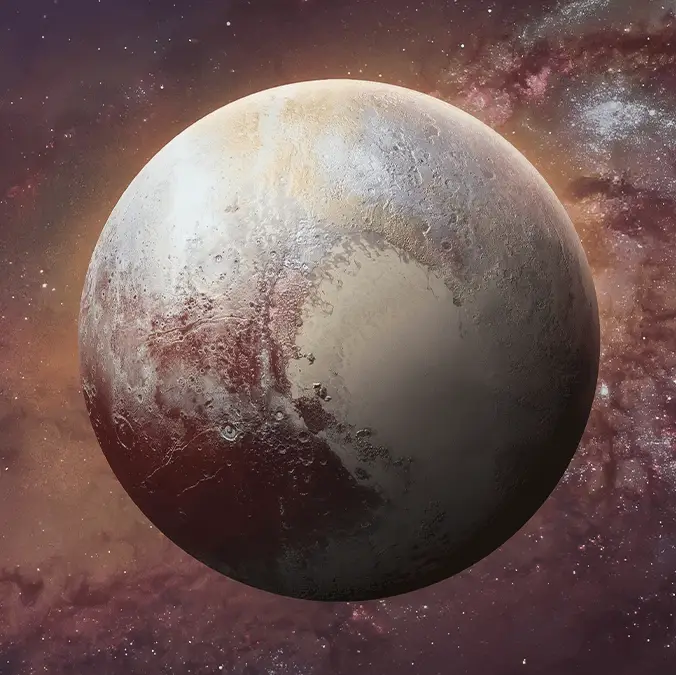
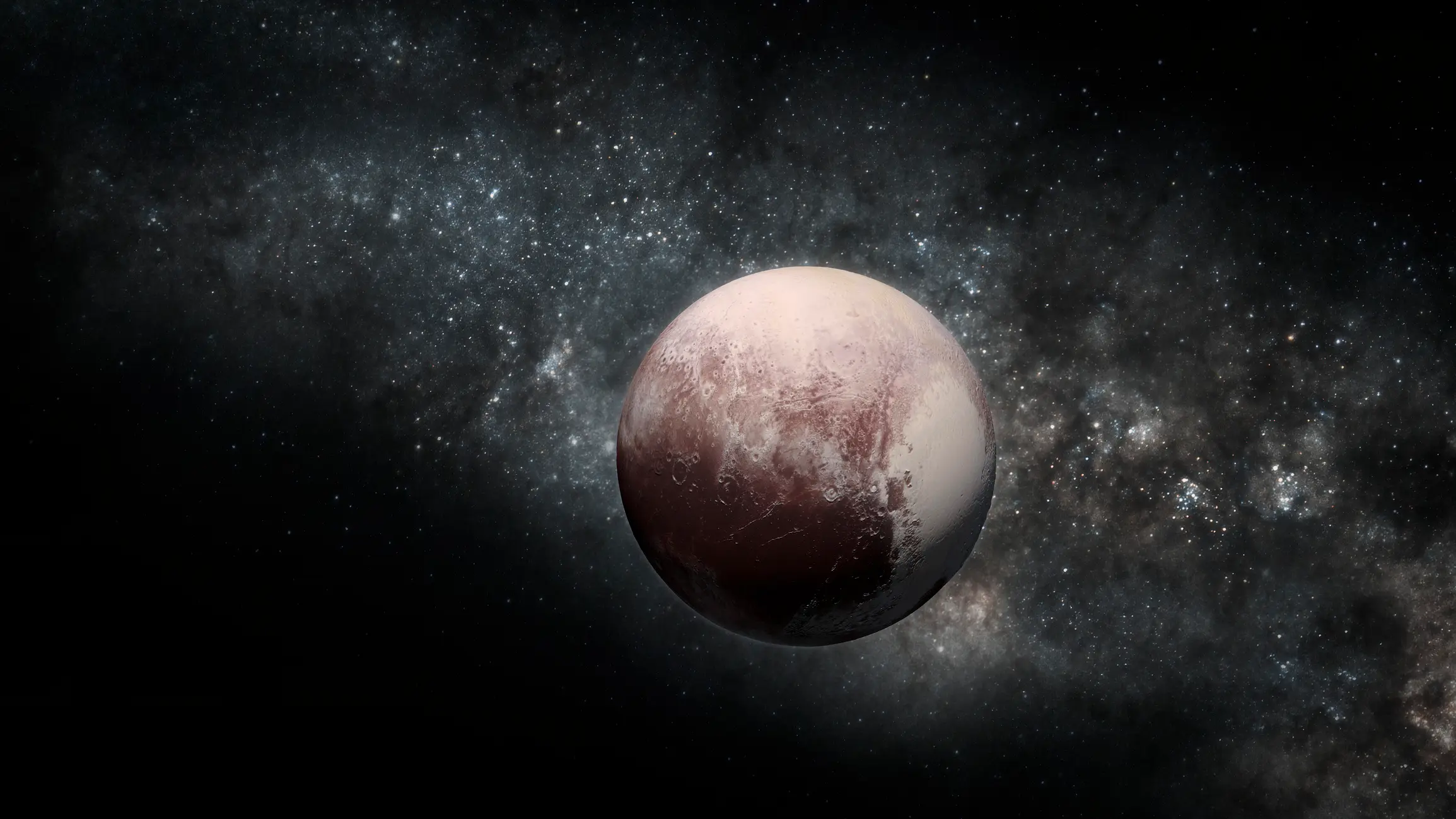
Photo that took nine years and 3,000,000,000 miles to take leaves viewers lost for words


A photo that took nine years and 3 billion miles to take has resurfaced on the internet and people are in awe.
Space photography has given us some of the most breathtaking images in human history. Each image tells a story of years of planning and represents incredible human achievement.
We've already covered the rare moment of NASA astronaut Suni Williams photographed on the International Space Station all the way from Earth's surface, while the story behind what many consider the 'most terrifying photo' ever taken in space is one to awe.
Now, a photo taken back in 2015 has resurfaced on Reddit showing the icy mountains of Pluto at probably the sharpest level of detail we've seen.
Advert
The grey peaks rise to 11,000 feet (3,500 metres) above the icy body's surface.
According to NASA, the close-up image was taken approximately 1.5 hours before New Horizon's closest approach to the dwarf planet. The spacecraft was reportedly 47,800 miles (77,000 kilometres) from the planet's surface.
"Although methane and nitrogen ice covers much of the surface of Pluto, these materials are not strong enough to build the mountains," the space agency reported. "Instead, a stiffer material, most likely water-ice, created the peaks."
Deputy GGI lead Bill McKinnon of Washington University, St. Louis (via NASA) said: “At Pluto’s temperatures, water-ice behaves more like rock.”
Geology, Geophysics and Imaging (GGI) team leader Jeff Moore of NASA’s Ames Research Center in Moffett Field, California, noted that the mountains 'likely formed no more than 100 million years ago and may still be in the process of building.'
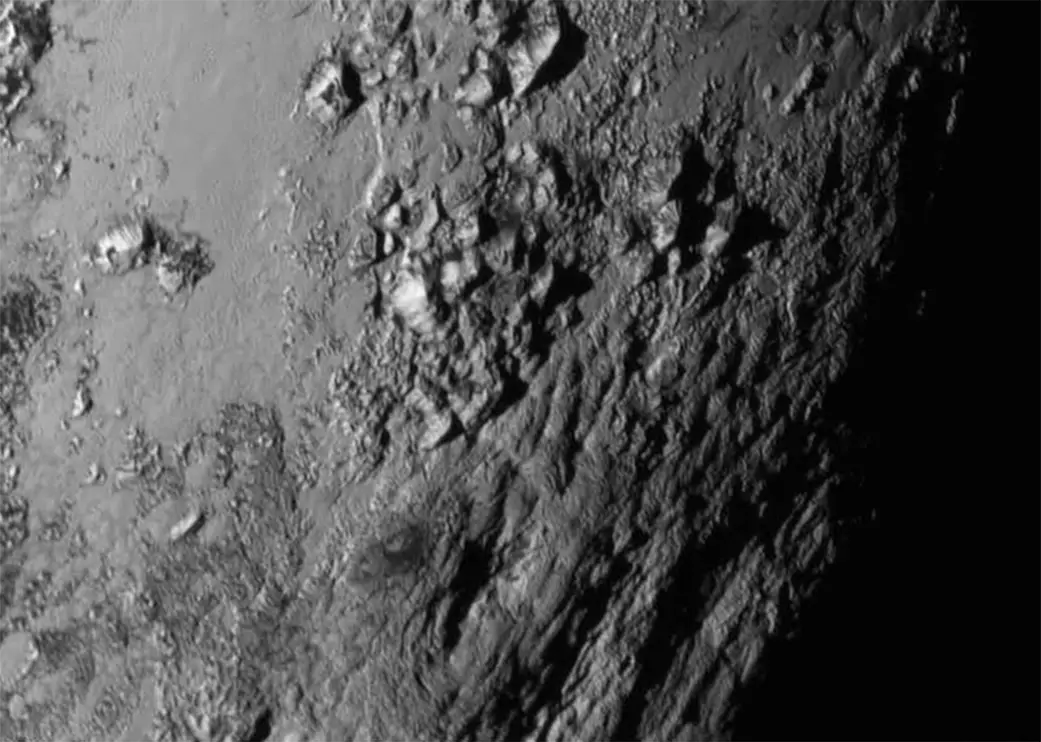
This suggests that the close-up region - which covers less than one percent of Pluto’s surface - may still be geologically active today.
Like the rest of Pluto, this area would have been bombarded by space debris for billions of years and should show extensive cratering, unless recent geological activity has had an impact, Moore stated.
"These close-up images, showing the diversity of terrain on Pluto, demonstrate the power of our robotic planetary explorers to return intriguing data to scientists back here on Planet Earth," said John Grunsfeld, the head of NASA's science directorate (via the BBC).
"This is so awesome!" one user exclaimed.
"Wow! Looks amazing and disappointing at the same time !" another wrote.
"When I was kid, when we learned that Pluto was a planet in picture books, the 'photo' of Pluto was a blurry grey dot," a third user remarked. "Now look at it. F***ing wild how far we've come in our ability to explore space."
Someone else joked: "I can see my house from there."