FBI arrests two men for creating AI 'porn ring' in first for new Trump act


The FBI have arrested two men for creating an AI 'porn ring' in a landmark first under Trump's new act, proving AI pornography is not a victimless crime.
Donald Trump spent much of his second term backing artificial intelligence as a primary driver of American innovation and economic growth. But there is one corner where his administration has drawn a line.
The FBI has charged two men in what appears to be among the earliest prosecutions under new federal legislation known as the TAKE IT DOWN Act (TIDA).
What is the TAKE IT DOWN Act?
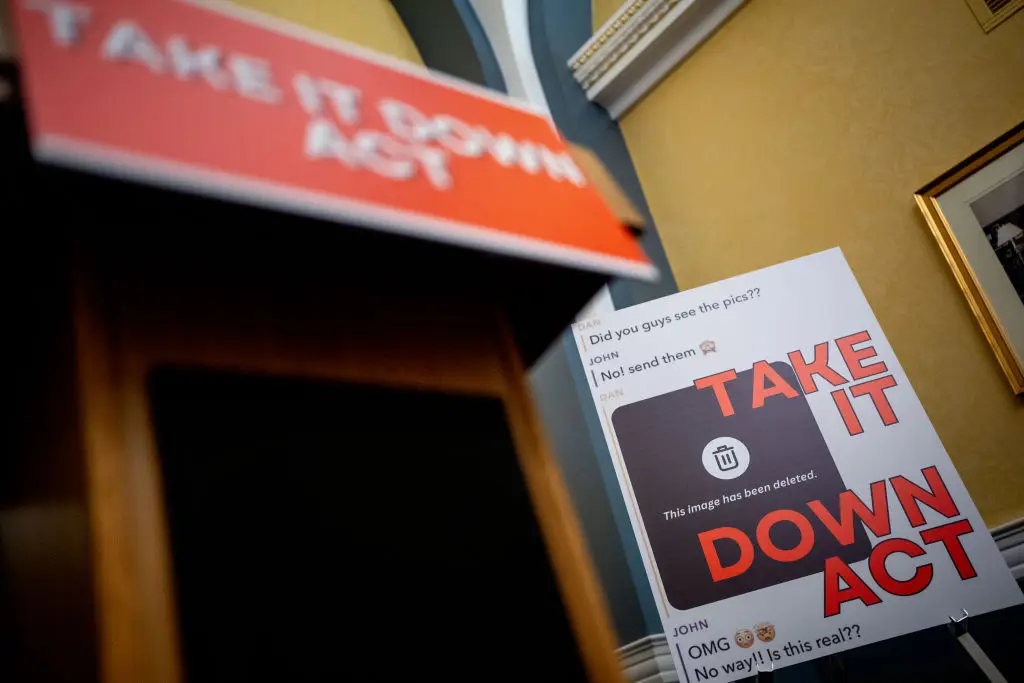
Signed into law in May last year, TIDA enforces strict penalties for anyone who publishes or distributes AI-generated 'deepfakes' and non-consensual intimate images, without the subject's consent.
"The TAKE IT DOWN Act is an acronym that stands for 'Tools to Address Known Exploitation by Immobilizing Technological Deepfakes on Websites and Networks Act,'" the US attorney's office wrote.
Advert
Deepfakes of this kind involve digitally replacing someone's face onto explicit imagery to make it appear as though that person is the subject of the content. As AI has advanced at a rapid pace, the tools required to produce convincing deepfakes have become faster to produce and more accessible than ever before.
The legislation drew rare bipartisan support in Congress and received a public endorsement from First Lady Melania Trump. It is one of the first major federal laws to address the misuse of AI in the creation of sexualised content.
What were the two men accused of?
Two suspects - who do not appear to have any connection to one another - were identified after FBI investigators visited porn websites and came across hashtags like #AI #Deepfakes or video titles like 'AI_tits' or 'Ass_AI.'
The first suspect was 20-year-old Arturo Hernandez who allegedly posted 113 albums of AI-generated sexualised images and videos that were viewed nearly one million times. The content involved around 50 women, including political figures, actresses, and musicians, as well as women he knew personally. One was identified as Hernandez's female classmate and the other was an Instagram friend.
However, Cornelius 'Neil' Shannon faces accusations of publishing around 360 AI-generated albums that attracted more than two million views. The 51-year-old's albums featured around 90 women, mostly consisting of politicians, actresses and musicians.
How did the FBI catch the suspects?
According to the investigators, the suspect-catching methods were relatively straightforward as the suspects don't always take steps to conceal their identity.
In Hernandez's case, geo-location data led agents to a second account that was re-posting all of his alleged uploads.
That account was reportedly linked to his PayPal, and the IP address used to log in matched Apple records showing the same IP had been used to access his iCloud account.
Agents also found that Hernandez followed one of his victims on Instagram and had saved the specific image used to generate AI content of her in a folder on his own account.
Despite attempting to disguise himself by registering a Gmail account under the nickname 'Ryan,' investigators noted he had used the same nickname on his Snapchat.
Meanwhile, Shannon's case was less detective work. According to the FBI affidavit, Shannon had apparently used his own photograph as his profile picture on the porn site. Cross-referencing Department of Motor Vehicle records with surveillance images, investigators identified a man pictured in a New York Mets shirt as Shannon himself.
Could more arrests be coming under the TAKE IT DOWN Act?
In this case, both men face up to two years in prison if convicted under TIDA, the attorney's office revealed.
“As alleged, the defendants used cutting-edge digital technology to create images that degraded and violated victims across the United States,” stated United States Attorney Nocella.
With TIDA now in force and federal investigators already demonstrating how easily they can track down offenders, it could be the start of a wider crackdown.
“This case makes clear that posting deepfake pornography is not a victimless crime, and our Office will pursue the criminals who engage in this reprehensible conduct with all the legal resources that the federal government can bring to bear," he added.