
Tech company will pay you to sit in a basement and talk to AI for 2 hours


Collecting data to train AI models on is proving to be one of the biggest challenges facing the industry, and that's why one tech company gearing towards a unique goal is willing to pay you to sit in a basement and simply talk to its models for hours.
Conduit claim to have the largest neuro-language dataset in the world and they've achieved that by simply brute forcing conversations with its model, leading to greater accuracy over a roughly 10,000 hours worth of content.
While most other AI labs opt to collect data from other sources, Conduit's goal requires the direct interaction with individuals, as they are training thought-to-text models with attempt to read your mind and create responses based on brain wave data.
"We train models to decode demantic content from noninvasive neural data," the company explains in a blog post regarding the immense data set they've collected, and you too could become involved in the project potentially shaping the future of AI interactions.
You can get paid to talk to an AI model
If you're in the proximity of Conduit's offices in San Francisco, you can earn between $50 and $55 for a two-hour session, with the potential to earn as much as $1,760 in total across the maximum number of sessions allowed per person.
Advert
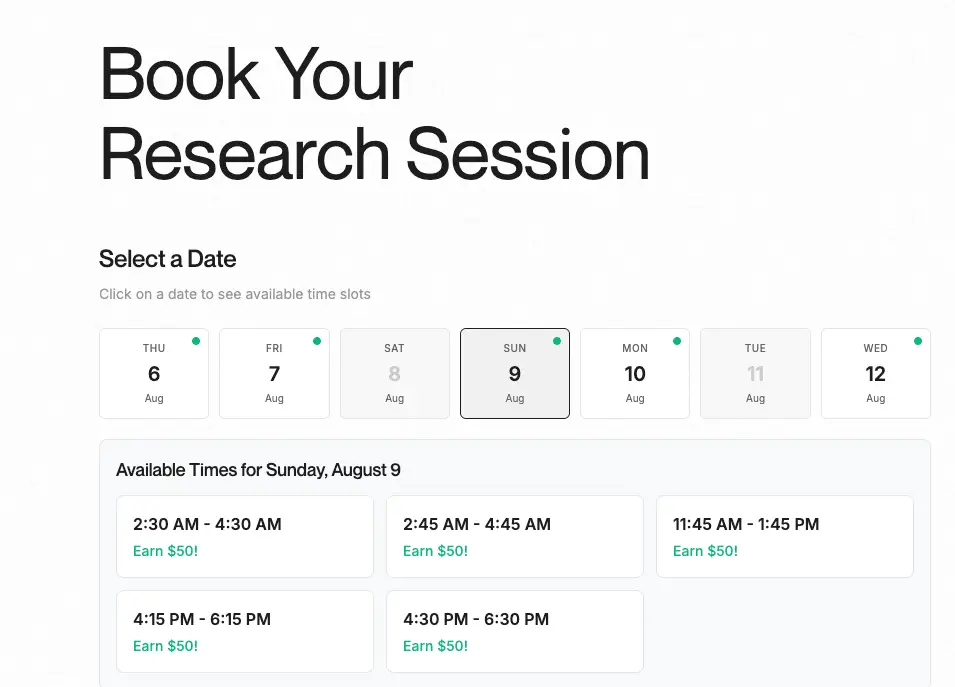
If you're wondering what you actually get up to, Conduit explains that sessions vary quite dramatically, with some "listening and speaking with an LLM, and some are reading and typing."
The end goal is to simply maximize the amount that people are typing or saying during the two-hour session, which increases the amount of data that is collected and trained for the AI model.
Participants are also incentivized to engage properly with the sessions and increase their performance levels by implementing a 'token quantity/quality scoring system', with people both paid more money and invited back if they produce good enough results.
Conduit even had to pare down its keyboard to avoid distractions and accidental key presses that would mess up the data, literally removing switches and keycaps to prevent anything that's not essential.

One of the most important things to achieve is an extensive data set from a wide pool of participants, which is why the number of training sessions you can participate in are limited.
"That is *not* just thousands of hours from dozens or hundreds of individuals," Conduit explains. "In an ideal world, most participants would only come in for one or two sessions, but that trades off hard against total hours."
What is Conduit trying to achieve
All of this training data is going towards the development of a model that can quite literally read your thoughts, but in a non-invasive way that contrasts the direct-chip-implementation of companies like Elon Musk's Neuralink.
As explained by Founding Researcher Naomi Bashkanshy, Conduit's prediction is that within perhaps even the next year, "the main way we'll talk with our AIs is with our thoughts.
"They will not be a super-smart automated intern or coworkers that you desperately try to keep up with," she continues in a blog post regarding her work. "They will be a natural, joyful extension of you."
It appears as if Conduit's goal is to have the AI work in the background, effectively optimizing and streamlining your life without you even realising it, as you simply need to be thinking about what you want to do in order for the model to pick up.
Collection of this training data has already shown promising results, with model predictions growing closer to grounded truth inputs throughout the data, but it's unclear whether the project will be viable as a complete and usable model any time soon.