
Adults baffled by infamous 5th grade math problem even ChatGPT can't answer correctly


Are you smarter than a fifth grader?
A math problem meant for 10- to 11-year-olds has left adults scratching their heads. The challenge has gone viral on social media as grown-ups struggle to find the correct answer. It asks fifth graders to calculate the total number of pages in a book after reading a certain number of pages over three consecutive days.
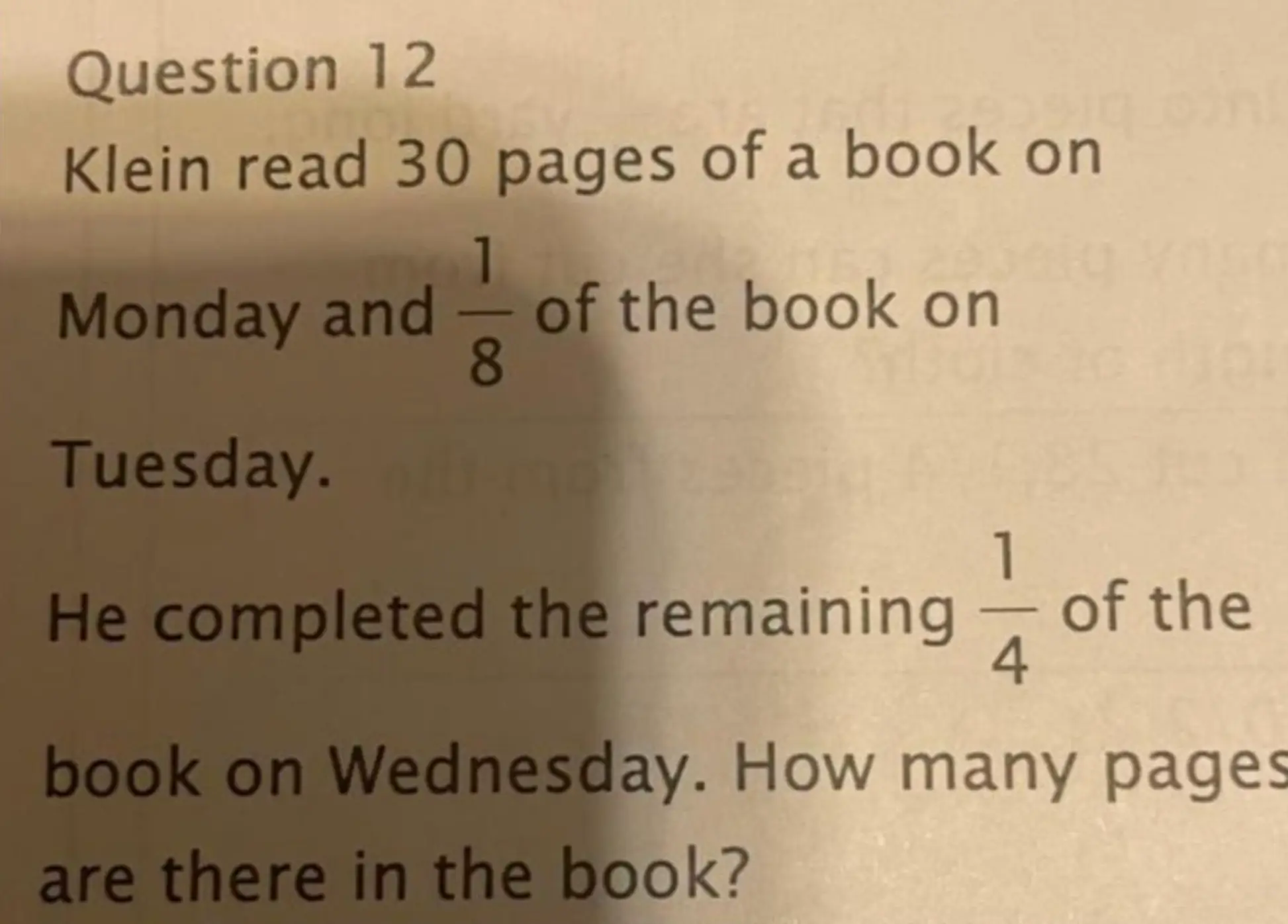
Here’s the task: “Klein read 30 pages of a book on Monday and 1/8 of the book on Tuesday. He finished the remaining 1/4 of the book on Wednesday. How many pages are in the book?”
The question has left many adults confused. One Reddit user stated: “And now we can see why Are You Smarter Than a 5th Grader worked as a TV show!”
Advert
Another Redditor added: “I always think to myself, 'Ugh. People should really be tested with basic skills before they're allowed to go out into society.' And then I see this and realize I shouldn't go out into society.”
Meanwhile, some Redditors decided to ask ChatGPT and apparently even OpenAI’s chatbot was confused. A Redditor said they received four wrong answers three years ago.
However, you don’t need a chatbot to help you solve this maths problem, as one Redditor explained the answer.
“We know he read a quarter and one eights of the book on Tuesday and Wednesday. One quarter = 2 eights. So he reads 3 eights of the book on Tuesday and Wednesday.
That must mean that 30 = 5 eights. We divide 30 by 5 to figure out what's 1 part of eight. 1/8 = 6.
So, 6 x 8 = 48 pages.”
The current flagship version of ChatGPT is GPT-5.1 which should be able to solve the maths task. Some Redditors suggested older versions of ChatGPT could have struggled to answer the task correctly.
Earlier this year we reported how ChatGPT responded to a 2,400 year-old math problem and why it stunned scientists in Cambridge.
They wanted to find out if the AI would use knowledge it already ‘held’ or develop its own solutions.
In the study titled ‘An exploration into the nature of ChatGPT’s mathematical knowledge’, the team asked the OpenAI chatbot to solve the ‘doubling the square’ problem.

First described by ancient Greek philosopher Plato, the brain teaser involves teaching somebody without mathematical knowledge how to double the area of a square.
Many would incorrectly double each side length. However, Plato noted that with the right 'prompts,' he could help people understand that the new square’s sides should be the same length as the diagonal of the original.
To their surprise, the researchers revealed that ChatGPT didn't take its usual approach of regurgitating its pre-existing knowledge of the famous solution.
Instead, the AI appeared to tackle it like a 'learner' would.
“When we face a new problem, our instinct is often to try things out based on our past experience,” said Dr. Nadav Marco, a visiting scholar at the University of Cambridge. “In our experiment, ChatGPT seemed to do something similar. Like a learner or scholar, it appeared to come up with its own hypotheses and solutions.”
The research was published in the International Journal of Mathematical Education in Science and Technology.