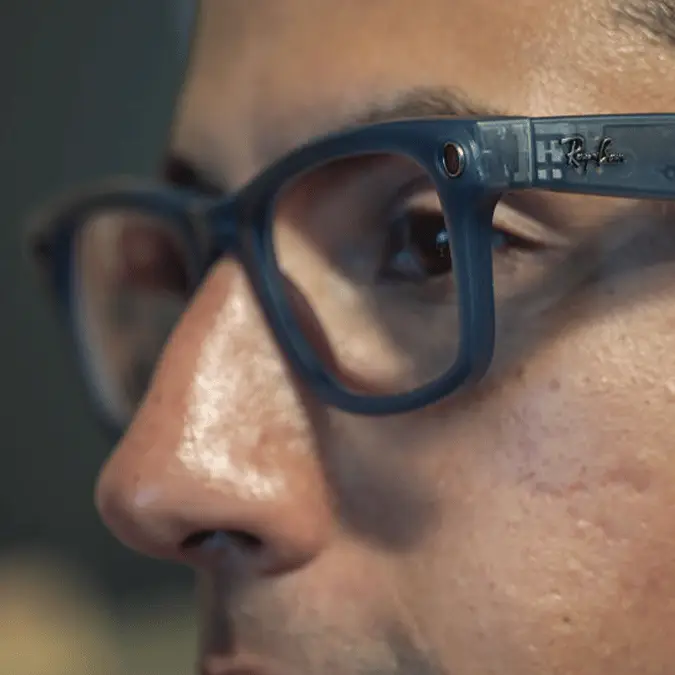
There’s now an app that tells you if someone’s spying on you with smart glasses


Smart glasses are becoming increasingly popular with improvements in the tech, yet one of the biggest concerns remains still the invasion of privacy that they cause for anyone caught in the camera's crossfire.
It has been a long time since the embarrassment of Google Glass, and wearable tech has finally reached a point where it's socially acceptable – to a certain extent – to use these gadgets in public.
Chief among these are the new AI smart glasses from Meta, featuring collaborations with Ray-Ban and Oakley to provide both fashionable and sports-oriented options for people to record their everyday lives.
Key to these devices are the cameras built into the frames, as these not only observe your surroundings to enable the various AI features, but allow you to record exactly what you're seeing and even upload directly to social media.
Advert

Recording in public is an unfortunate consequence of the proliferation of smartphones, yet these smart glasses bring a new concern to the table as they make the process far more discreet.
Not everyone using smart glasses is up to no good, but an alarming number of users have taken advantage of their 'hidden' nature to record people without their consent both in public and in private.
There are features built into the glasses that alert people when recording is active, but these can be circumvented on both a hardware and software level, prompting one developer to find an alternative.
As reported by the Metro, Yves Jeanrenaud, a sociologist in Germany, has now built an app called 'Nearby Glasses' that scans for nearby Bluetooth signals and alerts you whenever someone is using glasses within your vicinity.
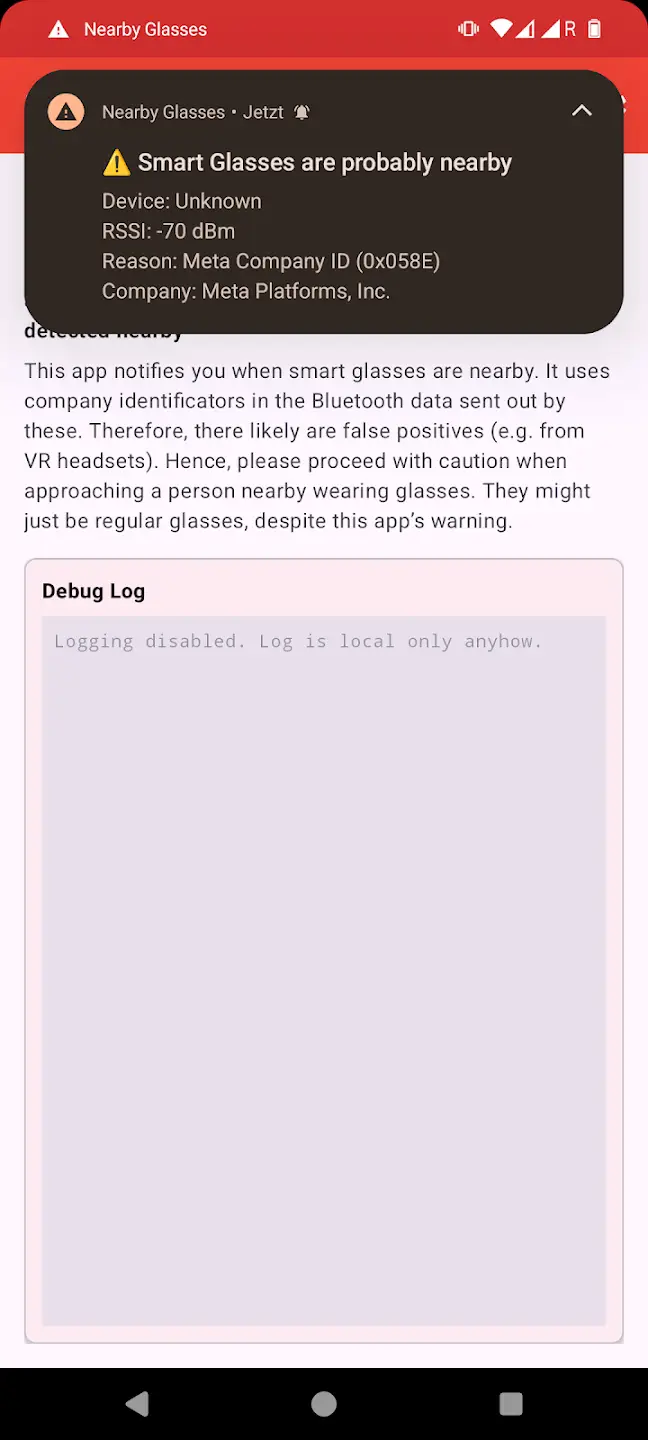
If it does manage to identify a pair, a notification will appear on your phone warning you: "⚠️ Smart Glasses are probably nearby."
Of course, this isn't always going to signal that someone is spying on you, but it might make you think twice about what you're doing, or prompt you to keep an eye out for any suspicious behavior or activity.
Jeanrenaud has admitted that the scanner isn't foolproof, noting that it can both produce false positives and fail to recognize some devices, yet it's far better than nothing and something to consider if you want to stay vigilant.
He was spurned on to create the app after the recent backlash to Ring Doorbell's dystopian Super Bowl half time advert, alongside footage captured by ICE agents during raids, and news that Meta would be adding creepy face recognition tech.
"Hence, I decided to try to do something," he explained.