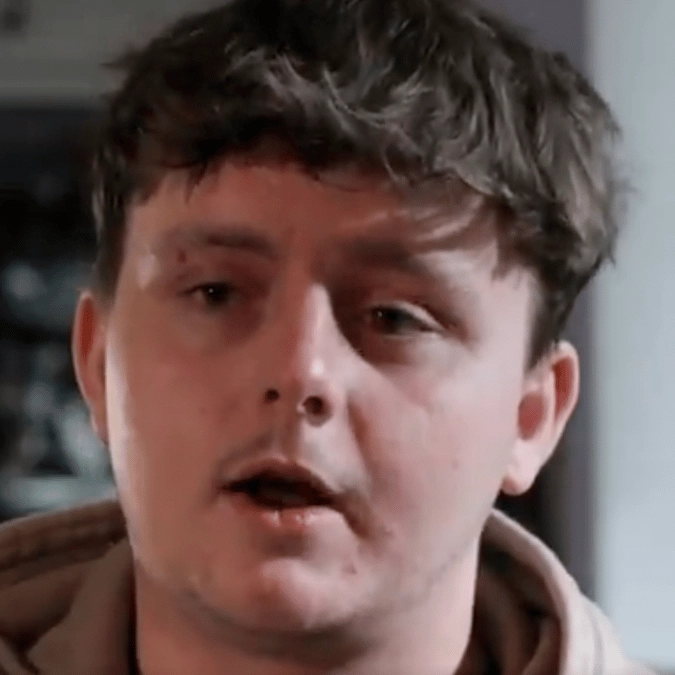
Teenager left with life-altering PTSD after being shown social media video


Warning: This article contains discussion of suicide and self-harm that readers may find distressing.
While social media is known for containing distressing content that should be shielded from younger audiences, and new laws are in place to prevent it as such, sometimes material on the internet slips through the net.
Sadly, for some, this content can have a profound impact on its viewers.
One teenager shared the devastating effect a graphic video had on his life.
Advert
In Year 8, Fraser McKenna witnessed a live suicide video during his break time at school.
"As I turned around, the phone gets chucked in my face and it's a man blowing his head off," Fraser said, adding that he would've been '12 going on 13' at the time of seeing the video.
"I was doing things I wouldn't usually do, clashing in the family, you know, behaving differently," he described.
His dad, Damien, explained that at one point, Fraser wanted to hurt himself with a knife and now understands what his son was going through at the time.
He described the 'worst part' as trying to restrain his son from hurting himself, to which he had to 'accelerate the restrain' to the point it was hurting his son. Then, Fraser broke down in tears on the kitchen floor while his dad held him.
"He broke down and we just hugged each other on the floor," Damien said. "I felt like I'd done that to my son, that I had to put him in this position to save him."
Damien added: "He was so upset, he hadn't done it to hurt me. He hadn't done it to hurt anybody else. He hadn't done it in a malicious, nasty way. This was pure desperation."
Damien also mentioned that he 'didn't feel any anger' towards his son. Seeing the pain he was in, he just wanted to let him know 'that it's alright.'
Four years on from unwillingly seeing the graphic content, Fraser was diagnosed with post-traumatic stress disorder. According to the now 18-year-old, he felt he couldn't speak to his friends about the issue for fear of being told to 'man up.'
Fraser's story follows news of calls to ban smartphones in schools in the hopes of improving children's education, concentration and wellbeing.
Dr. Emily Sehmer, a consultant child and adolescent psychiatrist, explains that worryingly, Fraser's case isn't isolated.
"It's very, very common, unfortunately. It's very sad to say it, but Fraser's case did not surprise me," she said.
As per the Department of Education, the Sky News report found that 99% of primary schools and 90% of secondary schools have 'clear guidance' in place to keep smartphones out of classrooms and prevent incidents like this from happening.