uniladtech homepage
  • News
    • Tech News
    • AI
  • Gadgets
    • Apple
    • iPhone
  • Gaming
    • Playstation
    • Xbox
  • Science
    • News
    • Space
  • Streaming
    • Netflix
  • Vehicles
    • Car News
  • Social Media
    • WhatsApp
    • YouTube
  • Advertise
  • Terms
  • Privacy & Cookies
  • LADbible Group
  • LADbible
  • UNILAD
  • SPORTbible
  • GAMINGbible
  • Tyla
  • FOODbible
  • License Our Content
  • About Us & Contact
  • Jobs
  • Latest
  • Archive
  • Topics A-Z
  • Authors
Facebook
Instagram
X
TikTok
Snapchat
WhatsApp
Submit Your Content
Scientist reveals how humanity’s first encounter with aliens will unfold and it's not what anyone expected

Home>Science>Space
Published 12:22 23 Dec 2025 GMT

Scientist reveals how humanity’s first encounter with aliens will unfold and it's not what anyone expected

The expert has said that our first alien encounter will be nothing like the movies

Rikki Loftus

Rikki Loftus

google discoverFollow us on Google Discover
Featured Image Credit: Colin Anderson Productions pty ltd/Getty Images
Aliens
Space
Science
News

Advert

Advert

Advert

A scientist has revealed how humanity’s first encounter with aliens will unfold and it is probably not what anyone expected.

While the images of grey intelligent beings zapping down to Earth from their flying saucers might be a popular depiction of aliens in pop culture, it isn’t reality according to experts.

Instead, it will be nothing like the stuff of Hollywood movies and instead is likely to be very different.

This is according to Dr David Kipping from Columbia University who has cited the ‘Eschatian Hypothesis’ which argues that the first alien civilization that humanity will encounter will probably be in its final moments.

Advert

Kipping has said that this is because they will likely be ‘unusually loud’.

As reported by the Daily Mail, the scientist stated: “Hollywood has preconditioned us to expect one of two types of alien contact, either a hostile invasion force or a benevolent species bestowing wisdom to humanity. But the Eschatian hypothesis is neither.

“Here, first contact is with a civilization in its death throes, one that is violently flailing before the end.”

Kipping argued in a new paper that the first examples of alien life we might encounter may not be typical but instead ‘rare, extreme cases’.

This is much like catching a dying star in the night sky, which is easier to spot as they are much brighter than normal stars.

He continued: “So, by extension, we should expect that the first detection of an alien civilization will be someone who is being unusually loud.

“Their behavior will probably be atypical, but their enormous volume makes them the most likely candidate for discovery.”

The expert also believes that the famous ‘Wow! Signal’, from 1977 could have been a close encounter with extraterrestrials.
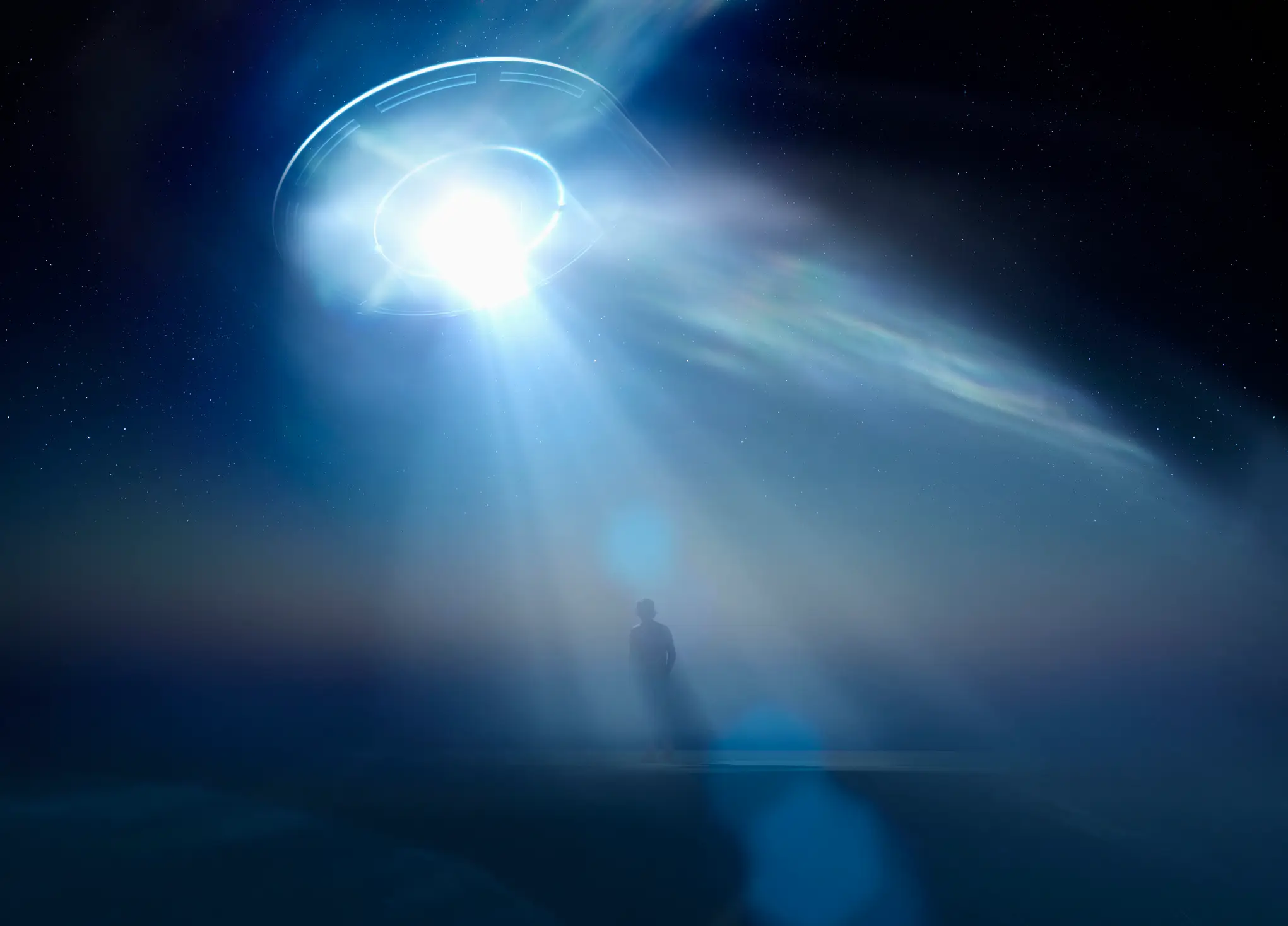
A scientist has said that our first alien encounter will be nothing like the movies (Colin Anderson Productions pty ltd/Getty Images)

The signal was a powerful, narrowband radio burst detected nearly 50 years ago by Ohio State University's Big Ear radio telescope, causing the leading astronomer, Jerry R. Ehman, to write ‘wow!’ next to the printout.

According to Kipping, this signal could have been an alien civilization broadcasting a final scream into the void in an act of desperation.

So, what could cause an alien species to get ‘loud’? It turns out that things like nuclear war can cause a planet to light up brighter, making it easier to detect on sensitive telescopes.

Meanwhile, aliens in distress might signal out to the universe in the hopes of getting a response from other lifeforms who may be able to help them.

Choose your content:

18 hours ago
23 hours ago
a day ago
2 days ago
  • chuchart duangdaw / Getty
    18 hours ago

    Expert warns upcoming 'Super El Niño' could seriously impact temperatures for rest of summer

    The chances of the extreme weather event keep going up

    Science
  • Kate Tolo / X
    23 hours ago

    Biohacker Bryan Johnson's girlfriend reveals intense skincare routine thats de-aged her 30 year old skin to 21

    She's used countless methods to reduce the age of her skin

    Science
  • Erik Simonsen / Getty
    a day ago

    How to see asteroid as big as five cruise ships visible from Earth this Saturday

    1997 NC1 was discovered in 1997, and will come the closest to Earth in 400 years

    Science
  • NASA Johnson
    2 days ago

    Scientists sound the alarm over the environmental impact of NASA’s plan to deorbit the ISS

    Plans to dump the space station in the sea have been challenged by experts

    Science
  • Scientists reveal what aliens might actually eat if they landed on Earth
  • NASA scientist reveals bizarre reason why aliens haven't contacted Earth yet
  • Harvard scientist predicts when aliens could be discovered on Earth and it's sooner than you'd think
  • Scientists issue first update in 15 years on alien contact placing strict 'no reply' rule on all humans