
Putin gives shocking response when questioned on existence of aliens


Vladimir Putin has given a shocking response after he was questioned about the existence of aliens.
This took place during an event last Friday (December 19) where the Russian leader was quizzed by a reporter about the possibility of alien life.
Specifically, Putin was asked about the 3I/ATLAS comet, which is being tracked over the next few months and is expected to pass at its closest point to Earth this month, reaching a distance of roughly 167 million miles away.
As the object travels through our solar system, it’s expected to pass by Jupiter in March 2026.
Advert
In a study, it was found that it took the object around 800 million years of travel to reach our solar system.
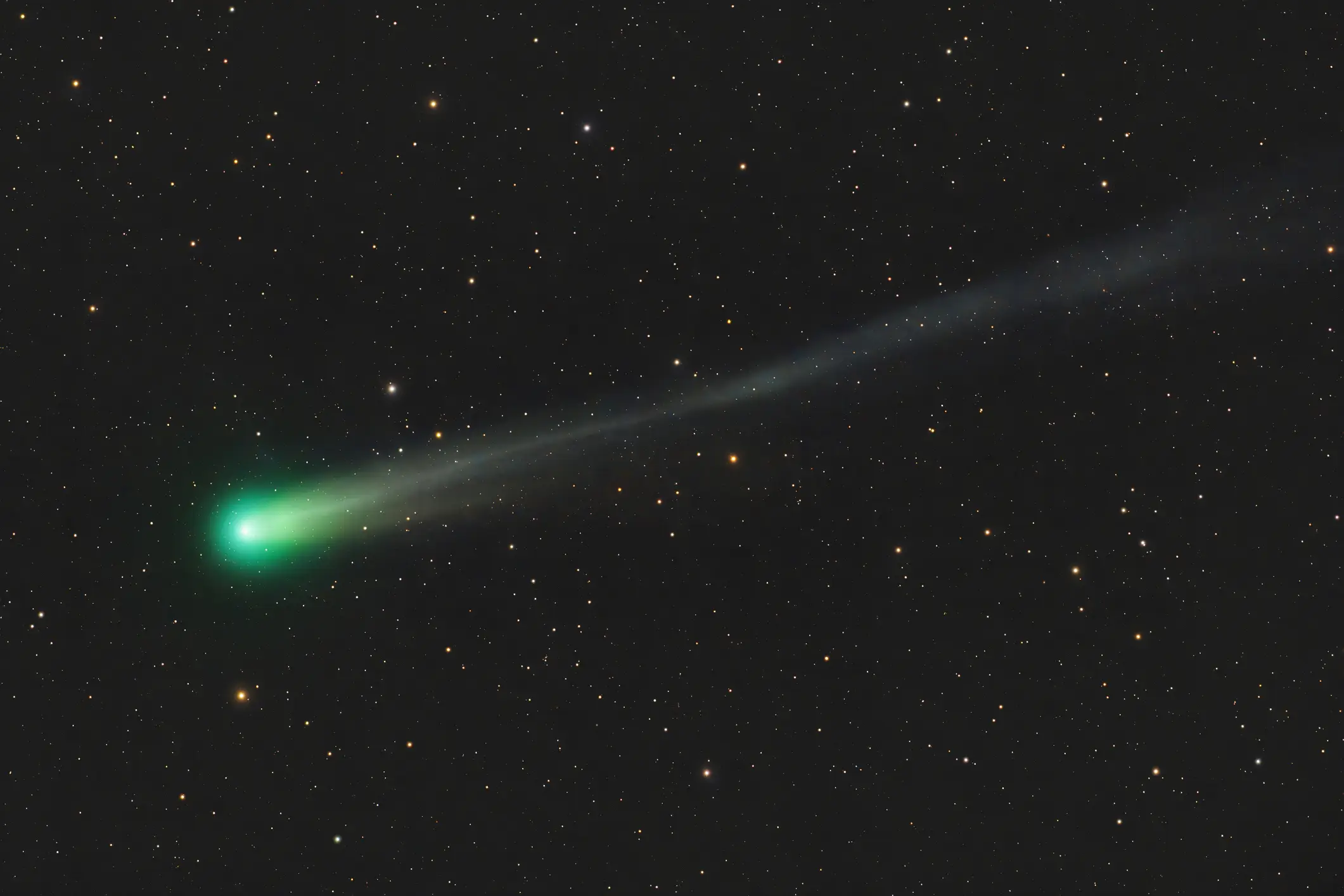
There has been some speculation as to whether, instead of a comet, the object could be extraterrestrial, which is what Putin was questioned on last week.
In response, the Russian president claimed that this information was to remain ‘strictly between us’, joking that the comet is Russia’s ‘secret weapon’, which sparked laughter in the room.
The acting NASA administrator, Sean Duffy, previously spoke about the comet, saying: “No aliens, no threat to life.”
According to Harvard physicist Avi Loeb and student researcher Shokhruz Kakharov, 3I/ATLAS originates back to a thicker part of the Milky Way galaxy’s disk.
This is an area where older stars are often found.
As reported by the Daily Mail, Loeb said: “Simply put, 3I/ATLAS is among the elders in our cosmic block.”
It is thought that the comet could be even older than our 4.6 billion year old sun.

The object is one of three interstellar objects that the scientist is observing.
In an article by Medium, Loeb wrote: “How quickly did it take these objects to migrate from the opposite side of the Milky-Way disk relative to the Sun? For 1I/`Oumuamua, the time is about a billion years; for 2I/Borisov, it is 1.7 billion years, and for 3I/ATLAS, it is 0.8 billion years. Through their orbit around the Milky-Way, all three objects travel a few thousand light-years closer to the Galactic center than the Sun does.”
The Milky Way is classed as a barred spiral galaxy, which means it has a central bulge, a bar-shaped structure of stars, and spiral arms extending from the ends of the bar. The disk of the galaxy, where most of the stars reside, is relatively flat and thin compared to the central bulge.