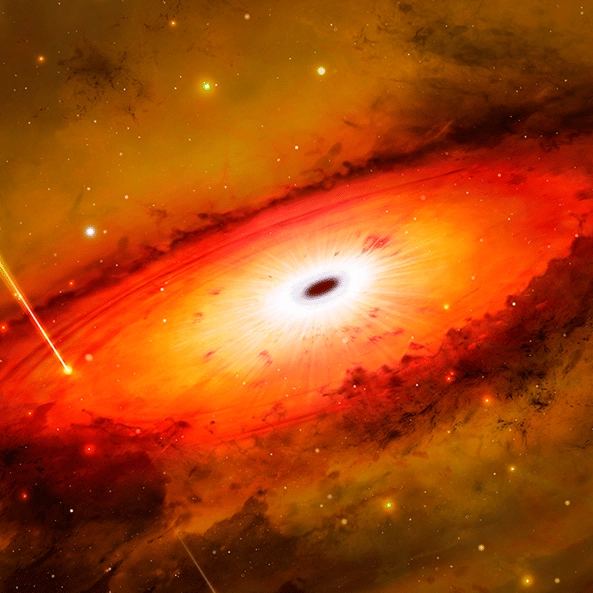
How black holes could actually ‘delete the universe’


Black holes could actually destroy the universe, or just keep information away from us never to be accessed again.
In a YouTube video by Kurzgesagt – In a Nutshell, the dark behaviour of black holes is revealed.
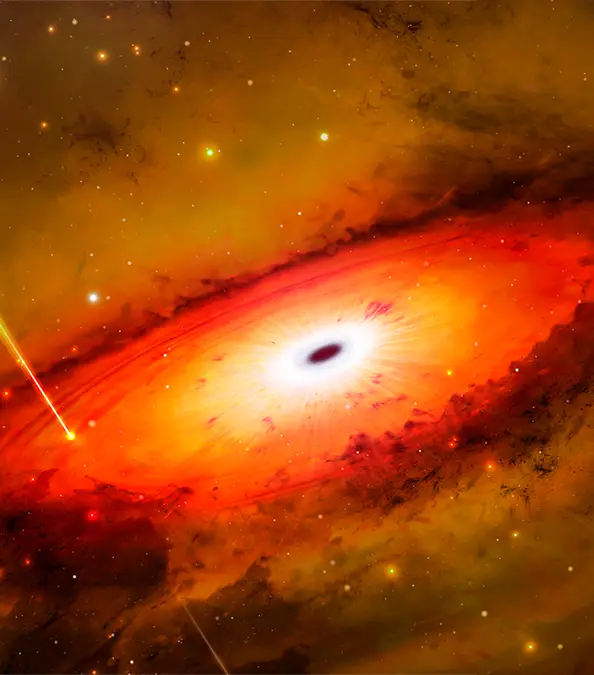
'A black hole appears when an extraordinary amount of matter is concentrated in a tiny space,' the video initially describes.
'Not even light can escape black holes, and so we perceive them as spheres of blackness. If you were to fall into a black hole, nothing bad would happen until well after you crossed its outer border: the event horizon.'
Advert
The animation explains the physics of information and its significance.
'Without information everything in the universe would be the same,' according to by Kurzgesagt.
At its core, everything in the universe is made up of the same components - atoms. It is only information and the arrangement of atoms that can allow us to distinguish between a chair and a banana, for instance.
Moreover, quantum mechanics argue that 'information is indestructible.' Although it might change shape, information can never be lost.
'Information tells us how things are different from each other and what used to be what.'
However, black holes do the opposite: 'They take different things and make them the same. They destroy information.'
Doing so creates the 'information paradox', which causes a serious problem.
'Without information, everything is relative. When it comes to our understanding of reality, we need absolutes.'
Black holes could cause one of three things could happen.
Either the information is lost 'irretrievably and forever' causing a complete overhaul of our laws of physics.
Nobody knows what those new laws of physics would look like - which can be both frightening and a little exciting.
Alternatively, it could be that the information is hidden.
'Maybe a little part of the black hole splits off and forms a baby universe,' the video suggested. Or the information is transferred to a place that we could never grasp. Not lost, but irretrievable.
Similar to a broken hard drive that contains all your family photos, the files are still there but you can never access them - thus, not much use to anyone.
But there's a third option: the information isn't lost at all.
According to the educational channel: 'Perhaps we've just been looking at this whole thing the wrong way.
'We know that black holes trap information and might delete it later, but we never thought about what they do with it in the meantime.
If information is actually stored on the boundary of a black hole, the Hawking radiation has a chance of learning about the information encoded there, and can carry it away.'
So, information is not lost when black holes fade away. But black holes might be key to understanding the nature of reality itself.
To fully appreciate the capabilities of black holes, we must 'change our understanding of reality in a fundamental way.'