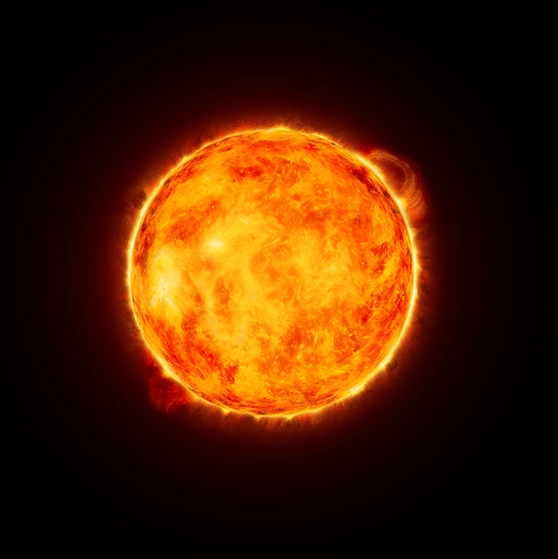
Mind-blowing new footage of the Sun shows surface is actually ‘fluffy’ in parts


When you think of the Sun, your brain will likely turn to a few descriptors.
You might immediately think that it's bright, hot and light - all of which would be correct - but what about fluffy?
Well, now scientists have captured some incredible and detailed footage of the Sun's surface - and yes, it does look remarkably fluffy in parts.
The video of the Sun was taken by the European Space Agency's (ESA) Extreme Ultraviolet Imager (EUI) instrument on Solar Orbiter back in September last year.
It looks like something out of a sci-fi movie, with threads of yellow swirling out from the surface.
Advert
According to the ESA, these hair-like structures are actually made up of charged gas - otherwise known as plasma - and are following magnetic field lines that are shooting out from the inside of the Sun.
The video was taken when the Solar Orbiter was around a third of the Earth's distance from the Sun - and this wasn't even the closest it got, making its nearest approach a bit later, on October 7. But even the closest point the orbiter could get to the Sun was around 43 million kilometers away - after all, the Sun is still an enormous ball of fire, and the ESA presumably wanted its expensive bit of kit to not get burnt to a crisp.
There's a lot going on in the video - including coronal 'rain' and coronal 'moss'.
FYI, coronal means anything to do with a star like the Sun - the 'moss' can be seen in the bottom left of the video, and is what the ESA calls 'delicate, lace-like patterns', whereas the 'rain' looks relatively dark and is actually made of 'higher-density clumps of plasma that fall back towards the Sun under the influence of gravity'.
To give a bit of perspective, those shoots of gas can actually reach heights of 10,000km - hinting at just how massive the Sun really is, if all this is casually going on on its surface.
In fact, one moment in the video shows an eruption, where cooler material is 'lifted upwards before mostly falling back down', says the ESA - but this eruption is actually bigger than Earth.
If you really want to get your head around the true scale of the Sun, you need to check out a recent viral picture of what Mercury looks like in front of it - the planet is pretty easy to miss, because it's completely overwhelmed by the giant star that powers our universe.