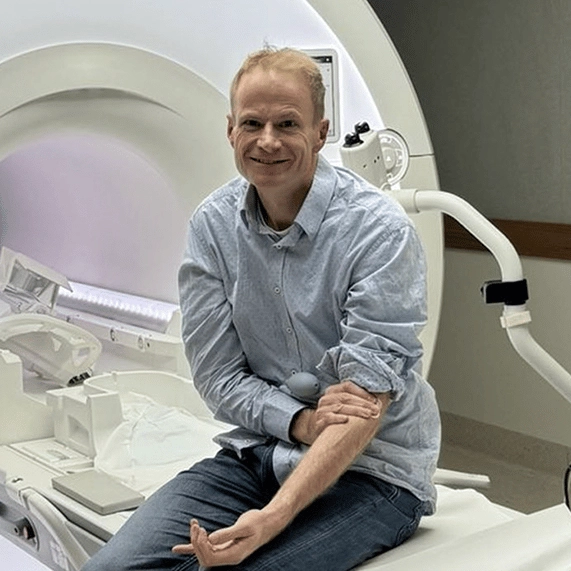
Doctor remains brain cancer-free a year on from his own pioneering treatment


An Australian doctor has been brain cancer-free for a year - thanks to a world-first treatment based on his own breakthrough research.
University of Sydney Professor Richard Scolyer has been working on a pioneering new treatment for a previously incurable form of brain cancer, glioblastoma - one that he himself was diagnosed with a year ago.
After having a seizure on a trip to Poland, a tumor was discovered in his brain, and he seized the opportunity to do a bold experiment.
By his own instructions, he adapted a treatment he had previously devised for melanoma patients - becoming the world's first brain cancer patient to have pre-surgery, combination immunotherapy.
Advert
Eight months on from an operation to remove the tumor, there's still no sign of recurrence at all, making him still cancer-free.
Median times for recurrence of this grade of brain tumor normally sit at around six months, so he's already outperforming some expectations.
Scoyler's bravery in putting his own life in the balance has seen him named as one of the Australians of the Year, and his university sounds proud in a statement: "By undertaking an experimental treatment with risk of shortening his life, he has advanced the understanding of brain cancer and is benefiting future patients."
Of course, as millions of people know, the journey through cancer can be a long one, with promising days and less optimistic ones, too.
However, if Professor Scoyler's treatment can be proven to help lengthen the median time for recurrence, that alone would be a huge step forward, while the possibility that it could prevent recurrence altogether means it could be even more important.
One of the many challenges of research is that there are so many different types of cancer, after all.
While this treatment has only been tried on Scoyler himself, and therefore only on the type of glioblastoma that he had, the hope would be that it could be tested against more types in the future.
This doesn't mean we've got any sort of guarantee that the pre-surgery combination immunotherapy will become a surefire cure, but it's another great avenue of investigation for researchers, that's for sure.
And, of course, it looks like it's all hinged on Professor Scoyler's willingness to tale a massive risk, which is as close as you can get to putting your money where your mouth is, in medical terms.