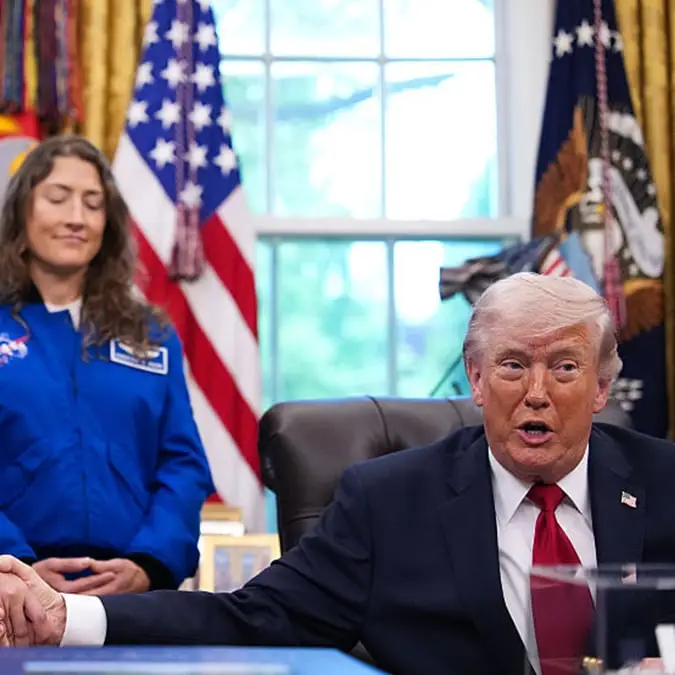
Trump makes savage comment about NASA chief's appearance in bizarre clip


President Donald Trump’s appearance at the Oval Office with the Artemis astronauts caused quite the stir yesterday (April 29).
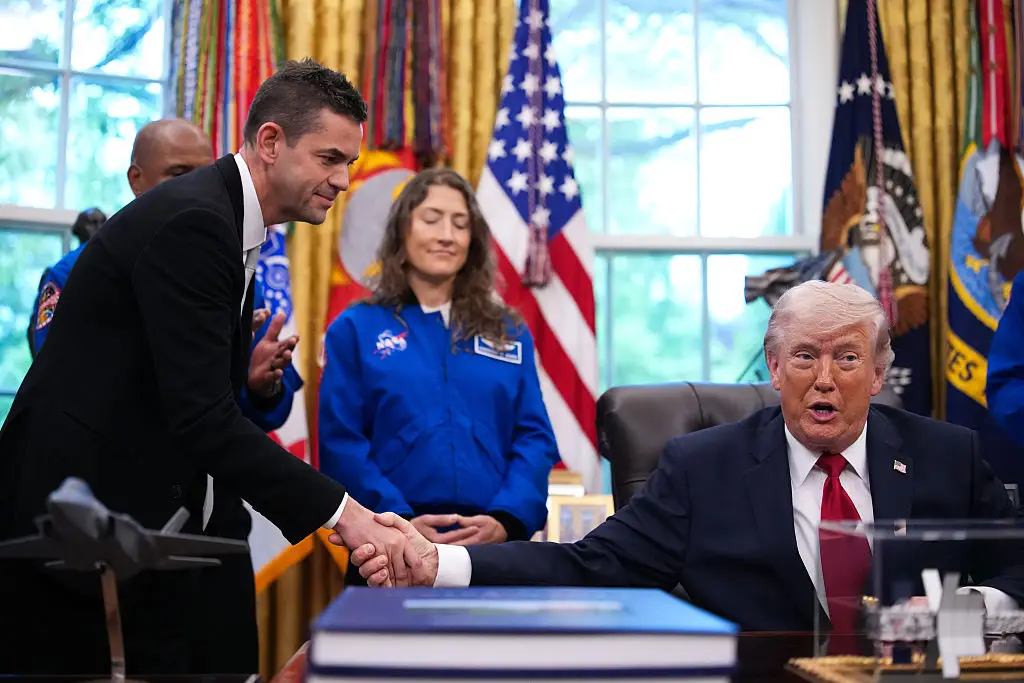
The president welcomed the astronauts, who had flown to the Moon and back earlier this month, to the White House where they took part in a press briefing.
However, it was during Trump’s address to reporters that had a lot of people on social media talking, in particular, one savage comment he made about NASA chief Jared Isaacman.
This happened when one reporter asked: “Are you considering relocating NASA’s headquarters out of DC once the lease is up?”
Advert
In response, the president quipped: “Well the best man to tell you that is the man standing right over here.” But it was what he said next that caught people's attention.
Turning to Isaacman, Trump continued: “You heard that question with those beautiful ears of yours? He’s got great hearing you know, super hearing.”
Isaacman replied: “Trick of the trade, sir.”
This interaction prompted many people to share their own reactions online, with one user writing on X, formerly Twitter: “He basically told him ‘you got some big ass ears’ I hated to laugh.”
Another joked: “Talk to this big eared motherf***er over here i dont know.”
And a third person added: “I swear he couldn't get away with most of his bulls*** if he was only 10% less funny.”
Artemis astronauts’ suspicious glance during Trump’s Oval Office address
This wasn’t the only strange moment during the address as viewers noticed two Artemis astronauts exchanging looks while appearing at the White House.
Talking about Navy pilots, the president said: “I interviewed some pilots, very solid people, and they said they saw things that you wouldn’t believe so, you’re gonna be reading about it.”
As Trump made this remark, people spotted astronauts Christina Koch and Reid Wiseman glance at each other briefly, leaving many to speculate why.
The Artemis II mission to the Moon
The recent mission to the Moon was made up of four astronauts - NASA’s Wiseman, Koch, Victor Glover, and CSA (Canadian Space Agency) astronaut Jeremy Hansen.
According to NASA, the team performed ‘a series of planned tests to evaluate systems, procedures, and performance in deep space’.
The space agency continued: “They will conduct manual spacecraft operations and monitor automated activities; evaluate Orion’s life-support, propulsion, power, thermal, and navigation systems; perform proximity operations activities; assess habitability and crew interfaces; and participate in science activities, including lunar surface observations and human health studies, that will inform science operations on future Moon missions.
“They also will practice mission-critical activities, including trajectory adjustments, communications at lunar distances, and piloting Orion during key phases of flight, culminating in a re-entry and splashdown to further validate the spacecraft’s performance with crew aboard.”