Exact time American's TVs and radios will go dark next week ahead of emergency test


Don't adjust your television sets and don't worry because (we're pretty sure) the world isn't ending. Instead, the Federal Communications Commission (FCC) and the Federal Emergency Management Agency (FEMA) have outlined plans for a test of the USA's Emergency Alert System in the coming days.
The test will interrupt TV and radio broadcasts in the event that important information needs to be put out to the public in an emergency.
Even those who know the EAS is going to be tested will likely be shocked when it blares on November 17, but we're here to help you prepare and put your mind at ease.
What is the Emergency Alert System?
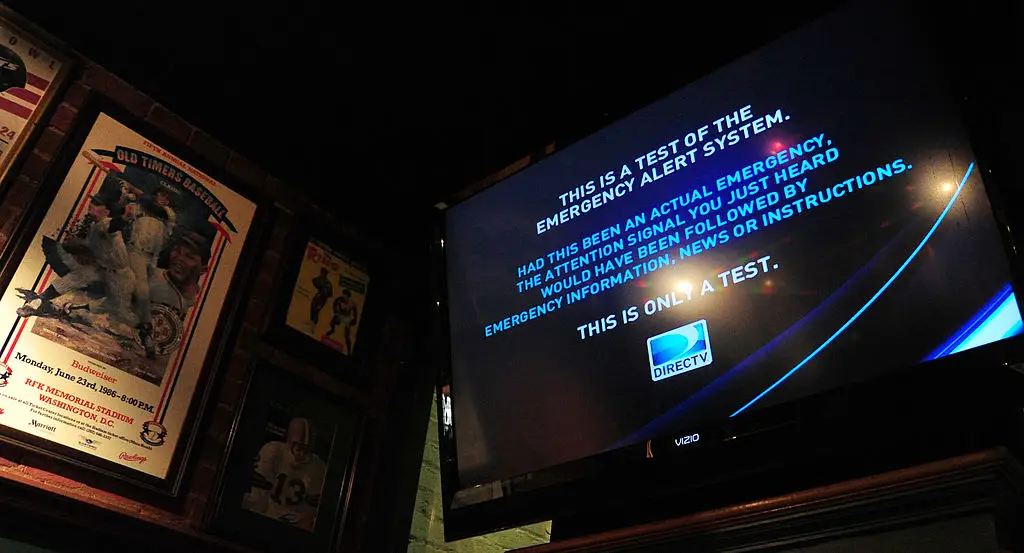
Covering cable, satellite and broadcast television, AM, FM and satellite radio, the EAS comes alongside the Wireless Emergency Alerts (WEA) that are blasted out from your mobile phones. Both sit under the broader Integrated Public Alert and Warning System (IPAWS), although the EAS was first introduced in 1997 after it replaced the existing Emergency Broadcast System (EBS).
Advert
Designed to allow the President of the United States to address the public within 10 minutes of a national crisis, it's largely used by state, local, tribal, and territorial authorities, as well as the National Weather Service. Only the POTUS has the authority to issue a national-level emergency message.
While the EAS is used thousands of times every year for state and local emergencies, it's thankfully never been used for a nationwide presidential alert.
Imminent threat alerts can warn about the likes of tornadoes and flash floods, as well as hazardous materials being released. Amber alerts are urgent bulletins used to help locate abducted or missing children, and public safety alerts focus on less imminent local threats or law enforcement warnings.
Notable uses since 1997 include an operator accidentally broadcasting a statewide immediate evacuation order across Connecticut instead of running a routine test in 2005. There was also a 2018 incident where an emergency management employee accidentally issued an alert warning that a ballistic missile threat was heading toward Hawaii.
One of the most infamous involved hackers breaching unencrypted EAS equipment in several states in 2013, issuing a fake emergency warning about "dead bodies rising from their graves." Thankfully, this isn't Night of the Living Dead.
When is November 2026's Emergency Alert System test?
Working in tandem, FEMA and the FCC will run a nationwide test of the EA on November 17 at approximately 2:20 p.m. Eastern Time. This works out as 1:20 p.m. Central Time (CT), 12:20 p.m. Mountain Time (MT), 11:20 a.m. Pacific Time (PT), 10:20 a.m. Alaska Time (AKT), and 9:20 a.m. Hawaii-Aleutian Time (HST).
Lasting for around one minute, the message will read: "This is a nationwide test of the Emergency Alert System, issued by the Federal Emergency Management Agency, covering the United States from 2:20 to 2:50 hours ET. This is only a test. No action is required by the public."
The alert will only interrupt participating TV, radio, cable, and satellite providers in both English and Spanish, meaning your phones won't get a message.
In the event there's an actual emergency or severe weather warning that needs to go out on November 17, FEMA and the FCC have pencilled in Thursday, December 3, as a backup date.
We're sure many of you will forget, but hopefully, you won't panic as much when the EAS warning interrupts your regularly scheduled viewing.