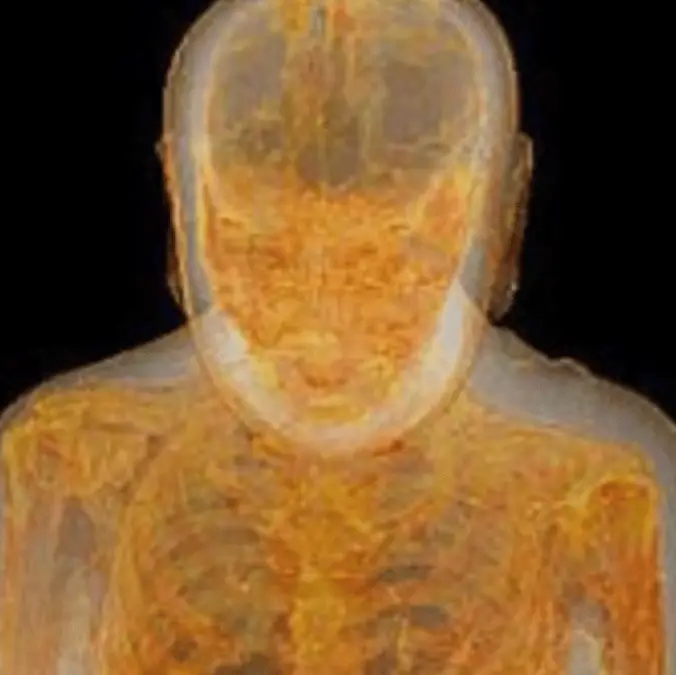
Astonishing scan reveals human body trapped inside 1,000 year-old buddha statue


History hides all kinds of secrets, yet scientists stumbled upon one rather unexpected find when they performed a CT scan on a Buddha dating back over 1,000 years, as a mummified monk was seen hidden inside.
There are so many things that remain lost and unknown about human history stretching back hundreds and thousands of years, and some seemingly obvious discoveries are only just being found today, including one that appears to link Egyptian leaders to the cosmos.
Often these finds are as unexpected as they are remarkable, and researchers can sometimes locate them in the most unlikely of places, with nothing summing that up better than a major discovery involving an ancient Buddha statue.
As reported by CNN, a statue of a sitting Buddha was transported from a temple in China to the Netherlands after being purchased by a private buyer with the intent to restore it, yet when it was brought to an expert an astonishing detail was noticed.
Advert
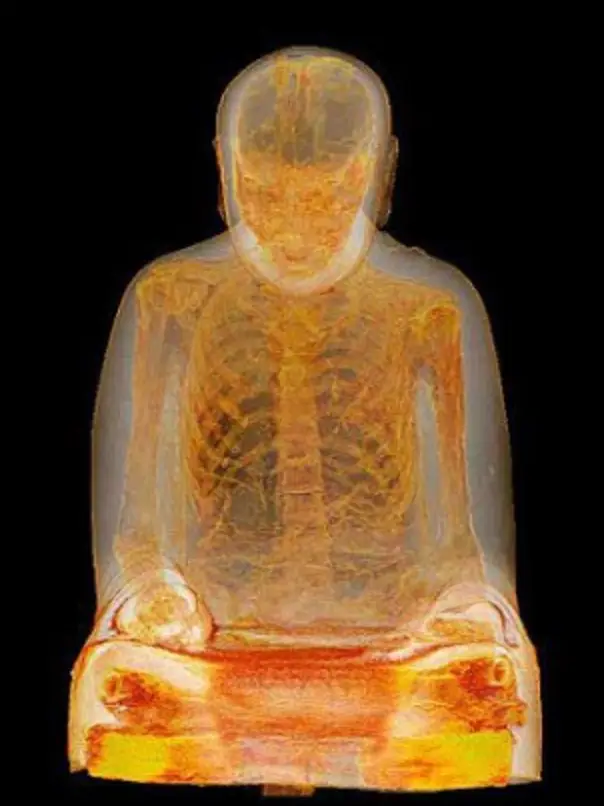
Discovered inside the 1,000-year-old statue was a mummified monk, identified by its skeleton in a CT scan, yet that was far from the only unexpected turn of events in this particular wild story.
Researchers and scientists that conducted close analysis of the body trapped inside soon discovered that the mummified body's organs were missing, being replaced instead with a strange material.
"We thought it would be lung tissue, but instead we found little scraps of paper covered with Chinese characters," explained Vincent van Cilsteren, a curator of archaeology at Drents Museum in the Netherlands.
These inscriptions revealed that the mummified body was that of a monk called Liuquan, who performed a process of self-mummification in order to prepare for life after death, and this was a common tradition in nations such as China and Japan.
This complicated process involved sticking to a certain diet and also drinking a poisonous tea that prevents maggots from eating away at the body after death, and Van Vilsteren expects that the body would have been preserved for a while before it was stored inside the Buddha we find it in today.
"We suspect that for the first 200 years, the mummy was exposed and worshipped in a Buddhist temple in China [...] only in the 14th century did they do all the work to transform it into a nice statue," the archaeology expert illustrates.
Many across social media were understandably equally left stunned by this discovery, with one comment on Reddit noting that "a monk hidden in plain sight for a millennium [is a] wild discovery."
Another joked that we need to "now put it back where you found it," because "we don't need a 1,000-year curse being unleashed or something."