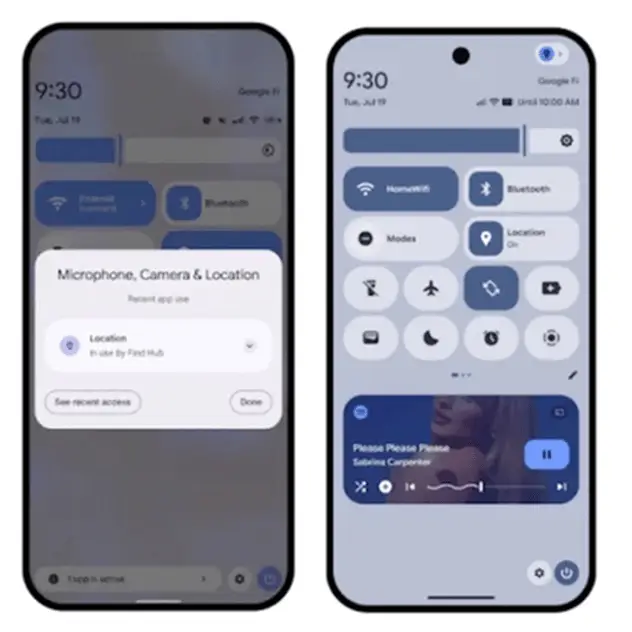
Why there's now mysterious blue dot on your Android phone's screen that wasn't there before


Tech companies have been tightening up their privacy, and a big part of that is being more transparent with their users.
Recently, iPhone users discovered what the orange and green dots on their screen meant which were quietly introduced.
Now Android users are getting something similar, and if you have spotted a small blue dot appearing on your screen without any explanation, here is what it means.

Advert
As part of Android 16 QPR 3, the blue dot is a new privacy indicator that signals an app is currently accessing your location data.
It works in a similar way to the green dot that appears when an app uses your camera or microphone. Both are designed to make it obvious when something on your phone is tapping into sensitive information.
The blue dot informs users when their location data is being accessed, so they can immediately adjust their settings if needed. Google began testing the update in December 2025 originally for Pixel phones before rolling it out to all Android phones in March.
However, it's worth noting that if the microphone, camera and location are all activated at the same time, the blue dot might appear green instead.
Google also announced other location privacy improvements with Android 17, including a new location button within apps that allows them to gather precise location data only once at the time of use, rather than collecting it continuously in the background.
At the same time, Google is competing directly with Apple, whose privacy features have become a major selling point for iPhone users.

However, the Alphabet-owned company faced controversy over its previous setting, which may have shaped its approach to transparency.
In 2018, an Associated Press report revealed that Google had been tracking user location even when the Location History setting was switched off.
The lawsuit was backed by 40 US state attorneys and was settled at a whopping $391.5 million. In response, Google agreed to make changes to how it tracks location data and how it informs users in the process.
Since then, Google has made a series of changes to how it handles location data, including auto-delete controls, Incognito mode in Google Maps, and greater user control over Maps timeline data.
Meanwhile, Android has been pushing for stricter security by launching new 'AI-powered protections and advanced safeguards' to keep users safe.