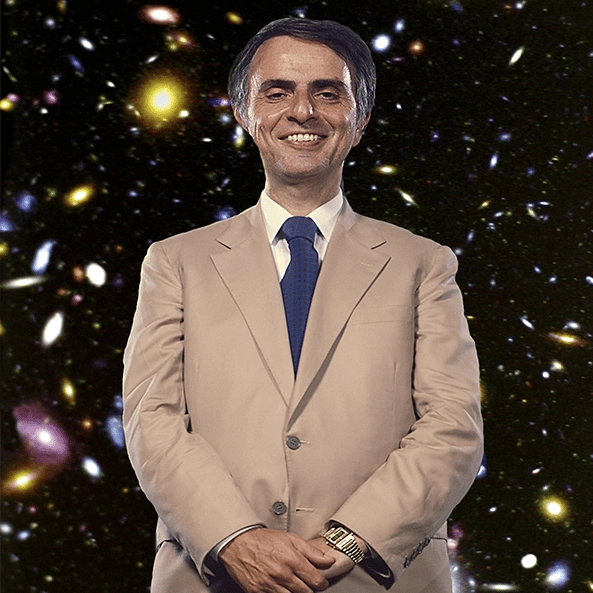
Astronomer Carl Sagan left inspiring message for the first humans on Mars before he died


Carl Sagan became one of the most famous voices in astronomy before his death in 1996.
And just before he died, he made a touching recording looking forward to the future. It's about three minutes long, addressing future astronauts who successfully made it to Mars.
In the late 1990s, this was a pretty distant goal, and we're still only in the early stages of planning missions to Mars with actual manned vessels, so it was a very forward-looking idea.
It's a lovely listen, and opens with American Sagan describing his surroundings in Ithaca, New York, including singling out the background noise of "a 200-foot waterfall, right nearby, which is probably, I would guess, a rarity on Mars, even in times of high technology".
Sagan goes on to talk about the inspiration that science fiction and scientific discoveries have given to generations of children and students that travel to Mars is a real possibility: "The scientists make a finding, it inspires science fiction writers to write about it, and a host of young people read the science fiction and are excited and inspired to become scientists to find out more about Mars, which they do, which then feeds again into another generation of science fiction and science."
Advert
The most interesting part of the recording comes when he talks directly to the astronauts, saying: "I don't know why you're on Mars. Maybe you're there because we've recognized we have to carefully move small asteroids around to avert the possibility of one impacting the Earth with catastrophic consequences, and, while we're up in near-Earth space, it's only a hop, skip, and a jump to Mars."
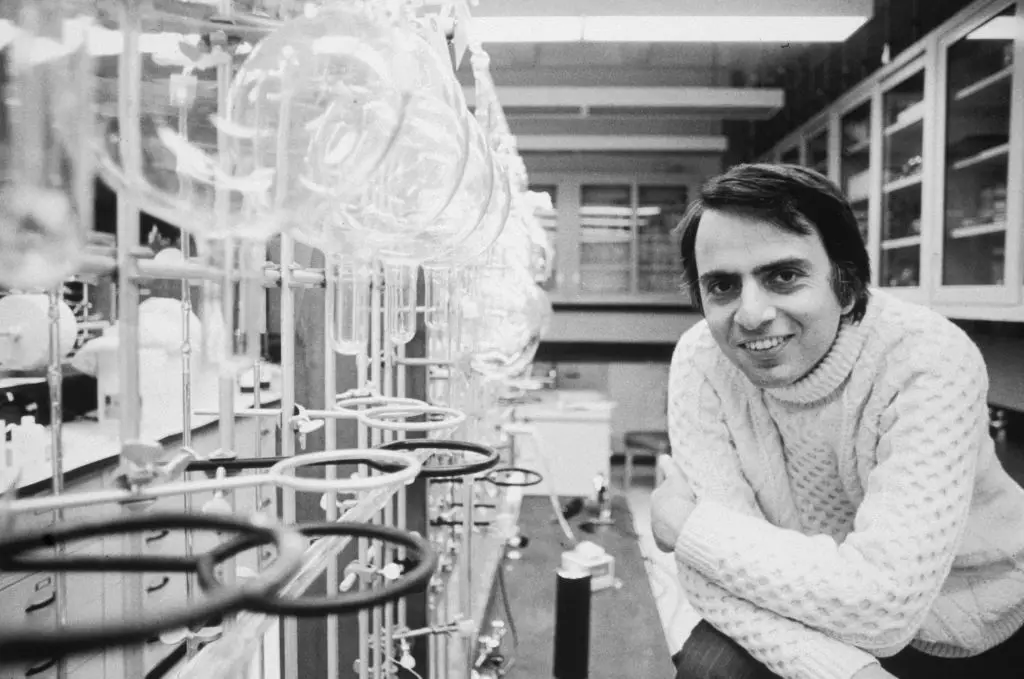
That shows how perceptive Sagan was - we are indeed in the process of developing the means to deflect asteroids from collision courses with Earth (although the risk of a serious collision is presently extremely low).
Another option he outlines is that we have colonized Mars because "if there are human communities on many worlds, the chances of us being rendered extinct by some catastrophe on one world is much less" - which sounds like something Mars-enthusiast Elon Musk might say.
Sagan's not done, though, outlining other options: "Or maybe we're on Mars because of the magnificent science that can be done there, the gates of the wonder world are opening in our time. Or maybe we're on Mars because we have to be, because there's a deep nomadic impulse built into us by the evolutionary process."
Sagan concludes that "whatever the reason you're on Mars is, I'm glad you're there. And I wish I was with you."
It's a lovely glimpse into the peaceful but insightful thinking that Sagan was capable of, demonstrating why he was such an asset to our scientific understanding of space.