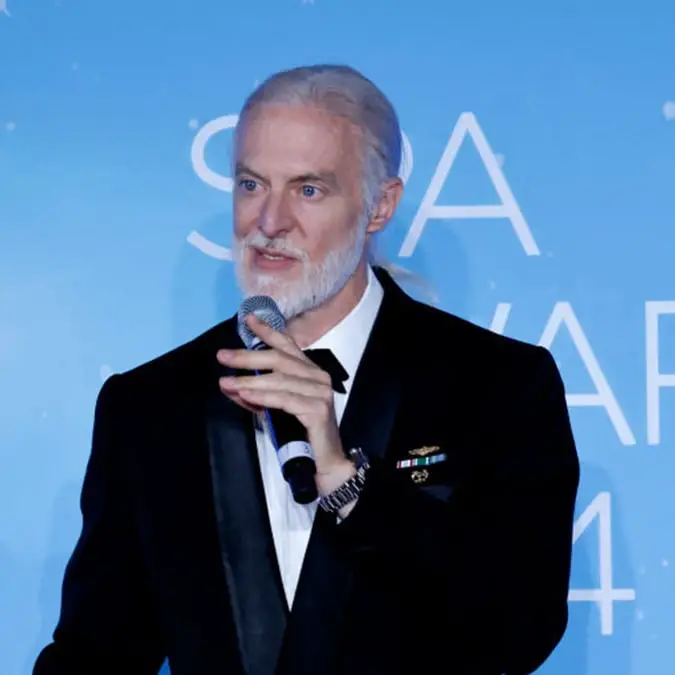
Featured Image Credit: Isa Foltin / Getty Images for Ad Alliance
A diver made an eerie discovery as he ascended 1,100 meters into the ocean. As mankind continues to reach to the stars with the likes of Elon Musk's hopes of making it to Mars, it's easy to forget the almost alien corners of planet Earth that we're yet to fully explore.
Now, one man explored the ‘deepest part of the planet’ as he plunged into the Mariana Trench.
In the video, a team of experts can be heard cheering as Victor Vescovo confirmed that he had reached the bottom.
One member of the team spoke to him from above the water surface, saying: “Understand, you are on the bottom. Congratulations Victor, congratulations.”
Advert
It is a record-breaking journey for the American explorer, who has become the first person to reach the deepest part of the Pacific Ocean, known as Challenger Deep.
During his exploration of the bottom of the ocean, Vescovo encountered some creatures at depth, including arrowtooth eels, cusk eels with transparent heads, grenadier fish, and ghostly snailfish.
This sparked a reaction from viewers, with many taking to social media to share their thoughts.
On Reddit, one user wrote: “I don’t understand how those creatures can exist at those pressures.”
Another said: “Surprised that they have eyes. Kind of useless in an environment completely devoid of light.”
And a third person added: “15,000 lbs of water pressure. These fish are literally aliens.”
However, fish weren’t the only thing discovered by Vescovo on his trek through the deepest part of the world.”
Footage captured of his voyage recorded that the explorer even saw a plastic bag, leaving many people shocked.
Replying in the YouTube comment section, one user said: “Shame that even in the deepest depths of the ocean you can see plastic waste.”
Another wrote: “The most mysterious, darkest, scariest creature to ever roam the oceans: THE PLASTIC BAG.”

And a third person commented: “I wouldn't be surprised if NASA found plastics on Mars.”
This dive into the Mariana Trench is part of a wider year-long challenge for Vescovo.
The explorer is planning to reach the deepest points in all of the Earth’s five oceans.
This includes the Puerto Rico Trench in the Atlantic, the South Sandwich Trench in the Southern Ocean, the Java Trench in the Indian Ocean, Challenger Deep in the Pacific, and Molloy Deep in the Arctic.
Vescovo has completed four of the dives in the challenge, with the only one yet to try out being Molloy Deep in the Arctic Ocean.
During the expedition, the explorer is covering a total of 47,000 nautical miles and has around 50 scientific lander deployments being undertaken alongside the submersible dives.