uniladtech homepage
  • News
    • Tech News
    • AI
  • Gadgets
    • Apple
    • iPhone
  • Gaming
    • Playstation
    • Xbox
  • Science
    • News
    • Space
  • Streaming
    • Netflix
  • Vehicles
    • Car News
  • Social Media
    • WhatsApp
    • YouTube
  • Advertise
  • Terms
  • Privacy & Cookies
  • LADbible Group
  • LADbible
  • UNILAD
  • SPORTbible
  • GAMINGbible
  • Tyla
  • FOODbible
  • License Our Content
  • About Us & Contact
  • Jobs
  • Latest
  • Archive
  • Topics A-Z
  • Authors
Facebook
Instagram
X
TikTok
Snapchat
WhatsApp
Submit Your Content
Largest structure in near universe that's 130,000 times larger than out galaxy discovered by scientists

Home>Science
Published 14:02 12 Feb 2025 GMT

Largest structure in near universe that's 130,000 times larger than out galaxy discovered by scientists

Quipu is one of five gigantic structures discovered in the nearby universe

Rebekah Jordan

Rebekah Jordan

google discoverFollow us on Google Discover
Featured Image Credit: Springel et al. (2005)
Space
Science
Discovery

Advert

Advert

Advert

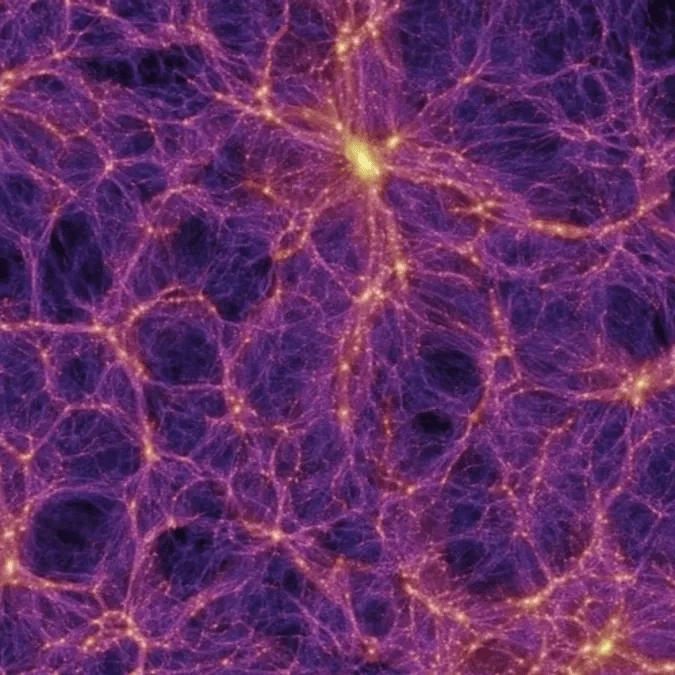
Researchers believe to have discovered the largest structure in the nearby universe which is over 100,000 times larger than the Milky Way.

Understanding how matter is distributed across the universe is one of the biggest challenges in cosmology and astrophysics.

Scientists have spent decades trying to map the web of galaxies, stars and cosmic structures that make up the universe in the hope of uncovering its origins.

And while the universe is rapidly expanding, gravity is working to pull everything together which proves to be an ongoing battle.

Advert
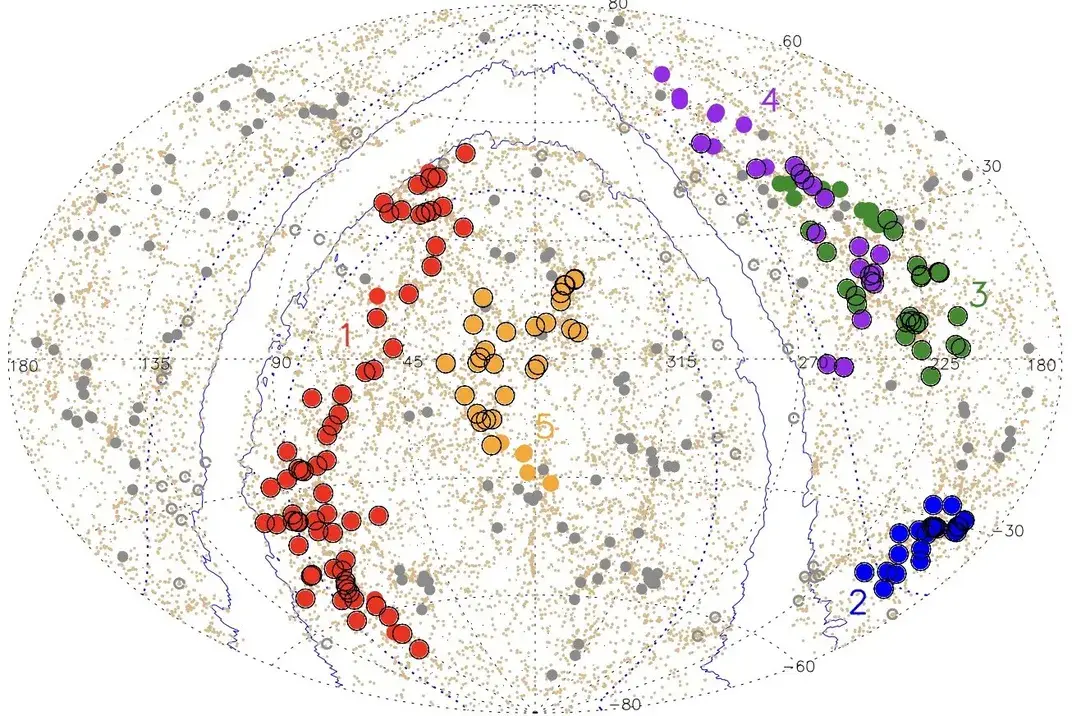
The five newly discovered superstructures: Quipu (red), Shapley (blue), Serpens-Corona Borealis (green), Hercules (purple) and Sculptor-Pegasus (beige) / Boehringer et al. / arXiv

Quipu is one of five gigantic structures recently discovered between 424 million and 815 million light-years away from Earth. Spanning 1.3 billion light-years, Quipu would fit 13,000 galaxies like the Milky Way whilst its solar mass is 2 × 10¹⁷ - equivalent to about 130,000 Milky Ways.

Named after the Incan counting system that used knotted cords on a strand for record-keeping, Quipu similarly has over-densities with larger clusters along its strands.

According to astrophysicist Alfredo Carpineti, Quipu has "one main strand of clusters of galaxies from which many strands depart."

Impressively, it collectively holds 45% of all galaxy clusters, 30% of all galaxies and a quarter of all matter within that region of the near Universe - yet they occupy only 13% of its volume.

While astronomers have found even bigger structures in the distant universe, those discoveries sometimes challenge our current models of cosmology.

Quipu is one of five large cosmic structures discovered and fits within expectations and simulations of the cosmos expect the presence of structures like Quipu out there.

But it might still have a major impact.

Its sheer size could affect how we measure the expansion of the universe, suggesting a possible solution to the famous Hubble tension.

The Hubble tension is the ongoing mystery of why different methods give different results for the universe’s expansion rate.
Jeremy Thomas / Unsplash

For now, scientists aren’t completely confident in linking Quipu to these cosmological mysteries, but its discovery is a reminder that there’s still a lot more to uncover about our universe.

Even though Quipu currently holds the title for the largest structure in the nearby universe, it’s not without competition.

The Hercules-Corona Borealis Great Wall stretches an incredible ten billion light-years, making it the largest known cosmic structure - at least in theory.

However, astrophysicist Hans Böhringer from the Max Planck Institute for Extraterrestrial Physics explained that scientists have yet to confirm whether it’s actually a single entity.

Choose your content:

2 days ago
  • Patricio Nahuelhual / Getty
    2 days ago

    Exactly what happens to your body when you eat heavily burnt food as cancer researcher warns against consuming

    Charring your meals can actually have an unexpected consequence

    Science
  • Marc Atkins / Contributor / Getty
    2 days ago

    Mathematician builds 11 models to predict the 2026 World Cup winner and the result is wild

    It's harder than you think to predict the outcome

    Science
  • Astronaut Franklin R. Chang-Diaz on the ISS (2002, NASA)
    2 days ago

    NASA orders emergency evacuation after Russia threatened to use a 'saw' on the ISS

    NASA outlined the 'high probability' of a 'bad outcome'

    Science
  • Kym Illman / Contributor via Getty
    2 days ago

    Scientist Neil deGrasse Tyson urges Trump's government to 'show the alien'

    The government's UFO disclosures have prompted a call to action from the prominent scientist

    Science
  • Scientists may have finally solved mystery of space’s strange 1.4-Hour radio signal
  • Scientists building ground-breaking nuclear device that could finally expose invisible universe
  • Scientists finally uncover what little red dots scattered throughout the universe actually are
  • Scientists uncover mysterious hidden chambers inside Egypt’s third-largest pyramid