China solves 'century-old-problem' with groundbreaking chip 1,000 times more powerful than Nvidia


Scientists have developed a revolutionary new chip.
Instead of following the digital computing model that's dominated for decades, this chip is analogue, meaning it performs calculations using its own physical circuits rather than the binary 1s and 0s of standard digital processors.
In a study published in the journal Nature Electronics, the team at Peking University said their device tackles two 'bottlenecks' facing modern computing.
First, it addresses the energy and data constraints that digital chips face in technologies such as artificial intelligence and 6G wireless networks.
Advert
Second, it claims to solve what they describe as a 'century-old problem' of poor precision and impracticality that has limited analogue computing and kept it from becoming a viable alternative to digital processors.
When researchers tested the chip on complex communication problems, such as matrix inversion calculations used in massive multiple-input multiple-output (MIMO) wireless systems, it matched the accuracy of standard digital processors while consuming approximately 100 times less energy.
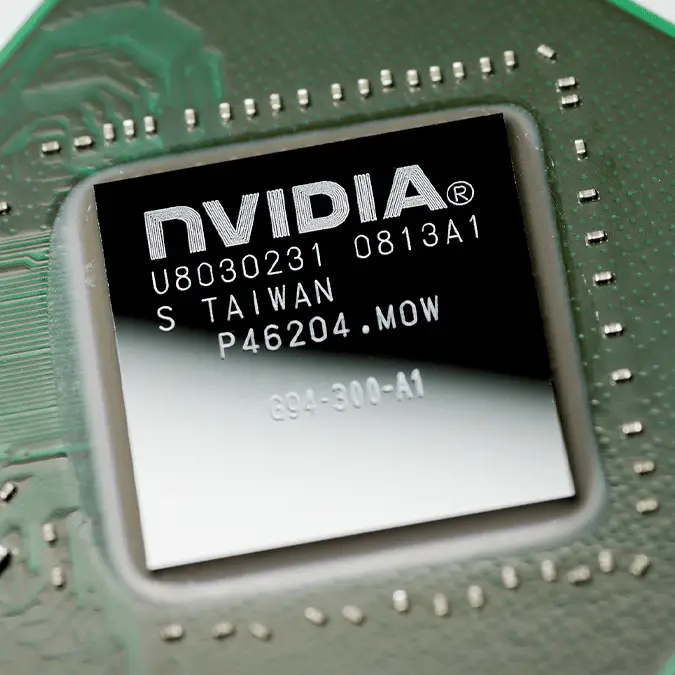
After making certain adjustments, the researchers said their device dramatically outperformed leading GPUs, including the Nvidia H100 and AMD Vega 20, by up to 1,000 times.
If you don't know, both these chips are major players in AI model training. Nvidia's H100 is the newer version of the A100 graphics cards, which OpenAI used to train ChatGPT.

If the Chinese researchers' claims prove accurate, their analogue chip could make a massive leap for computing architecture as we know it.
The chip is built from arrays of resistive random-access memory (RRAM) cells. These cells both store and process data by adjusting how easily electricity flows through each cell.
Instead of using binary 1s and 0s like conventional processors, this analogue design processes information as continuous electrical currents flowing through its network of RRAM cells. By doing so, the chip avoids the energy-intensive task of constantly shuttling information back and forth between the processor and external memory.
"With the rise of applications using vast amounts of data, this creates a challenge for digital computers, particularly as traditional device scaling becomes increasingly challenging," the researchers said in the study. "Benchmarking shows that our analogue computing approach could offer a 1,000 times higher throughput and 100 times better energy efficiency than state-of-the-art digital processors for the same precision."
Interestingly, analogue computing is actually one of the oldest forms of computing known to humanity.
Discovered in a shipwreck off the coast of Greece in 1901, the Antikythera mechanism is estimated to have been built more than 2,000 years ago and to have solved calculations with remarkable precision.
According to the researchers, this is just the beginning. In the future, they aim to build larger, fully integrated chips that can tackle more complex computational challenges at even greater speeds.