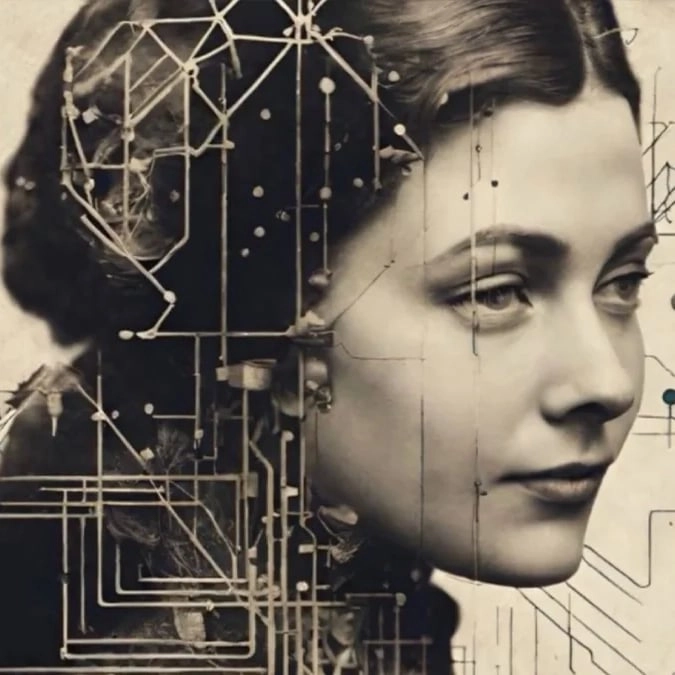
Researcher who 'immortalized' herself in an AI bot reveals most 'unsettling' thing she found


The expansion of artificial intelligence is showing no signs of slowing down, and now, it could even ‘immortalize’ us into a digital format long after we die.
AI systems known as deathbots or griefbots are changing the way people grieve for loved ones, as the AI model is designed to simulate the wording, characteristics and personality of a deceased person that the living can communicate with.
But is there a sinister side to it? Cardiff University’s Dr Jenny Kidd is leading a research project into the concept alongside Dr Eva Nieto McAvoy.
The project is Synthetic Pasts, with the media and digital culture scholars drawn to questions about cultural heritage, memory and archives.
How accurate are AI deathbots to the person they are simulating?
As part of that work, Kidd decided to ‘immortalize’ herself in her own griefbot. Speaking to UNILAD Tech, she explained: “Interestingly, what was most unsettling wasn’t a strong sense of presence, because as we noted in the article the systems we built were actually quite poor at maintaining coherence or internal consistency; they would contradict themselves, lose track of ideas, or generate responses that didn’t really resemble us.
Advert

“What was unsettling was seeing how a small amount of personal data could still produce something that superficially resembled a person, even while being clearly inaccurate. The system could mimic certain stylistic patterns or repeated lexical choices, but the interaction itself was often shallow and inconsistent.”
Despite the AI system being able to use Kidd’s digital traces to assemble a griefbot that appeared to be her, she realized that it ‘doesn’t actually capture’ who she is.
Kidd continued: “At the heart of these systems’ offer is a claim that they can facilitate connection, continuity or even comfort, but they are poorly optimized to do those things in an authentic way. Instead they offer a kind of bland line of best fit - something safe, smooth and, ultimately pretty weird.”
Instead of being able to capture an authentic likeness and the complexities of a person, the digital culture expert found that the griefbot created a ‘patterned caricature’.
Can AI deathbots help people who are grieving?
Whether or not these bots can actually benefit people seeking support while grieving is still up for debate, but Kidd is not convinced, adding that she is ‘very critical’ of whether the service is something that could ‘ever be convincingly achieved, and whether it is even desirable’.

Still, that morbid fascination many people have with communicating with the dead is nothing new and while seances and ouija boards might be the stuff of movies, AI griefbots could become a reality.
Kidd believes that ‘whether this alleviates or exacerbates grief is still an open question’, going on to say: “There is a risk that conversational simulations flatten a person into a smoother, more compliant, and more platform-friendly version of themselves. For some, that may be comforting. For others, it may be jarring or emotionally destabilizing. It is often just quite exploitative of everyone involved. At the very least, such systems demand far more ethical and regulatory scrutiny than they currently receive.”
Will griefbots become the modern day ouija board?
While the invention of photography and video also acts as a way to immortalize people beyond their lifetime, the development of AI ‘supercharges this landscape’.

Kidd added: “We have concluded in our research that the disruptive potential of these tools is overplayed by the industries who create them, for the moment at least. Lots of these services struggle to find a user-base, and there is good reason for that: there are many established rituals, norms and values around death, grieving and practices of remembering which are culturally situated, and which are going to be difficult to disrupt. At the moment, many of these new platforms and services fail within a couple of years which would suggest the appetite to do death differently is not yet widespread.
“For now, it is probably more likely that we will see people use their preferred conversational LLM system as a mechanism to do this work - to help them deal with grief and bereavement. So, ChatGPT, Claude, Meta AI and others - services that are anyway becoming more embedded as a part of peoples’ everyday media use.”